A110
Battery: breakdown recovery
To avoid all risk of sparks:
- Ensure that the "energy consumers" (ceiling lights, etc.) are switched off before disconnecting or reconnecting a battery.
- When charging, stop the charger before connecting or disconnecting the battery.
- Do not place metal objects on the battery as this could create a short circuit between the terminals.
- Always wait at least one minute after the engine has been switched off before disconnecting a battery.
- Make sure that you reconnect the battery terminals after refitting.
WARNING
Before carrying out any work under the bonnet, the ignition must be switched off (please
see "Starting, stopping the engine" in Section 2).
Connecting a battery charger
The battery charger must be compatible with a battery with nominal voltage of 12 volts.
Do not disconnect the battery while the engine is running. Follow the instructions given by the manufacturer of the battery charger you are using.
WARNING
Special procedures may be required to charge some batteries. Contact your approved
dealer.
Avoid all risk of sparks which may cause an immediate explosion, and charge the battery
in a well ventilated area.
Risk of serious injury.
WARNING
Handle the battery with care as it contains sulphuric acid which must not come into
contact with the eyes or skin. If it does, wash the affected area with plenty of cold
water. If necessary, consult a doctor.
Keep any flames, red hot objects or sparks away from the battery components (risk
of explosion).
When working in the engine compartment, the mechanical components may be hot.
Risk of injury.
Starting the vehicle using the battery from another vehicle
If you have to use the battery from another vehicle to start, obtain suitable jump
leads (with a large cross section) from an approved dealer or, if you already have
jump leads, ensure that they are in perfect condition.
The two batteries must have an identical nominal voltage: 12 V. The battery supplying the current should have a capacity (amp-hours, Ah) which is
at least the same as that of the discharged battery.
Ensure that there is no risk of contact between the two vehicles (risk of short circuiting
when the positive terminals are connected) and that the discharged battery is properly
connected. Switch off your vehicle ignition.
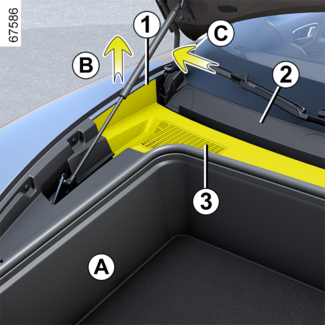
Depending on the vehicle, it may be necessary to remove the scuttle panel grille run
channel to access the battery.
To do this:
- hold the rear end of the wing 1 of the scuttle panel grille run channel 3 and pull it upwards to unclip it from the scuttle panel grille 2;
- take hold of the run channel on the left-hand side then pull it upwards towards you (movement B) to unclip it completely;
- move to the left (movement C) to release the right-hand side of the run channel and facilitate its movement in relation to the strut;
- place the run channel 3 gently on a clean and dry surface.
WARNING
Vehicles not fitted with storage compartment A
Due to the presence of mechanical components:
- it is forbidden to store objects under the bonnet;
- when working on the engine compartment, ensure that you do not leave anything (cloths, tools, etc.) Otherwise, this may lead to the mechanical components being damaged or cause a fire.
Risk of damage or fire;
- When working in the engine compartment, the mechanical components may be hot. The engine cooling fan may also start at any moment.
Risk of injury.
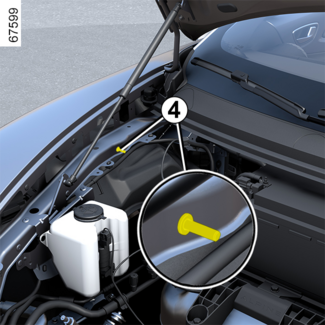
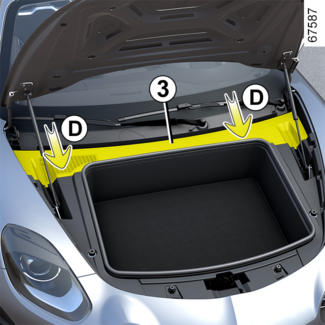
Refitting the scuttle panel grille run channel
It is important to properly reposition the run channel 3.
To do this:
- position the run channel 3 (movement D);
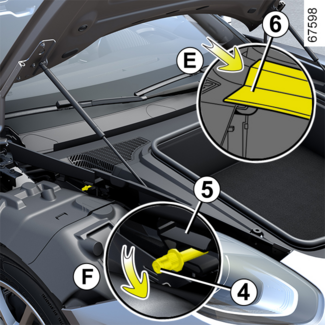
- depending on the vehicle, insert the run channel 3 into the wing cover housing 6 (movement E);
- clip the component 5 at each end of the run channel to the bodywork mounting 4 (movement F);
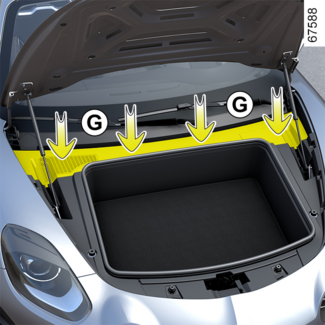
- press the run channel (movement G) to clip it in.
Note: if you have difficulty clipping on the run channel 3 (movement G), check if it has been inserted into components4 and 6: risk of damage to the run channel.
Depending on the vehicle, unclip the battery cover.
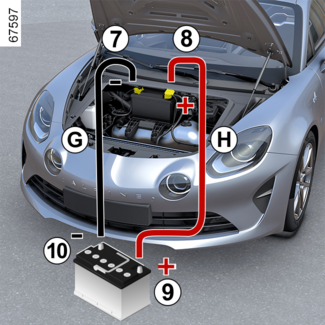
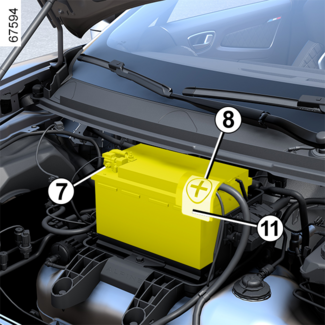
Lift the red tab 11 to access the terminal 8 (+). Connect the positive cable H to the terminal 8 (+) then to the terminal9 (+) of the battery supplying the current.
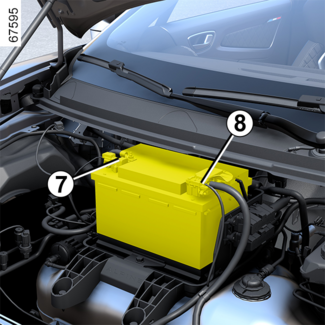
Connect the negative cable G to the terminal 10 (˗) of the battery supplying the current and then to the terminal7 (˗) of the discharged battery.
Start the engine of the vehicle supplying the current and run it at intermediate engine
speed.
WARNING
Ensure that there is no contact between cables G and H and that the positive cable H is not in contact with any metallic component in the vehicle supplying the current.
Risk of injury and/or damage to the vehicle.
If your vehicle's engine does not start immediately, switch off the ignition and wait
a few seconds before repeating the operation.
With the engine switched running, disconnect cables G and H in the reverse order (7 - 10 - 9 - 8).