A290
There are two ways to attach child seats: using the seat belt or using the ISOFIX system.
Attachment via the seat belt
The seat belt must be adjusted in order to ensure it works in the event of sudden braking or impact.
Ensure that the strap paths indicated by the child seat manufacturer are observed.
Always check that the seat belt is correctly fastened by pulling it up, then pulling it out fully whilst pressing on the child seat.
Check that the seat is correctly held by moving it from side to side and back to front: the seat should remain firmly fixed.
Check that the child seat has not been installed at an angle and that it is not resting against a window.
warning
Do not use the child seat if it risks unfastening the seat belt restraining it: the base of the seat must not rest on the buckle and/or catch of the seat belt.
warning
The seat belt must never be twisted or the tension relieved.
Never pass the shoulder strap under the arm or behind the back.
Check that the seat belt has not been damaged by sharp edges.
If the seat belt does not operate normally, it will not protect the child.
Consult an approved Dealer.
Do not use this seat until the seat belt has been repaired.
Attachment using the ISOFIX system
Authorised child seats ISOFIX are approved in accordance with current regulations if any of the four cases below applies:
- universal ISOFIX 3-point forward-facing seat;
- semi-universal ISOFIX 2-point seat;
- vehicle-specific;
- i-Size which has either:
- a strap which attaches to the third ring of the seat concerned;
- or a strut that rests on the vehicle floor, compatible with the approved seat i-Size, the role of which is to prevent the child seat from moving in the event of a collision.
In the latter three cases, check that your child seat can be installed by consulting the list of compatible vehicles.
warning
No modifications must be made to the component parts of the originally fitted restraint system (seat belts, ISOFIX, seats and their mountings).
Attach the child seat with the ISOFIX locks, if these are provided. The ISOFIX system allows quick, easy and safe fitting.
The ISOFIX system consists of two rings and, in some cases, a third ring.
warning
The ISOFIX anchorage points have been exclusively designed for child seats with the ISOFIX system.
Never fit a different type of child seat, seat belt or other objects to these fittings.
Check that nothing is obstructing the anchorage points.
If your vehicle has been involved in a road accident, have the ISOFIX anchorage points checked and replace your child seat.
warning
Before using an ISOFIX child seat that you purchased for another vehicle, check that its installation is authorised. Consult the list of vehicles which can be fitted with the seat with the equipment manufacturer.
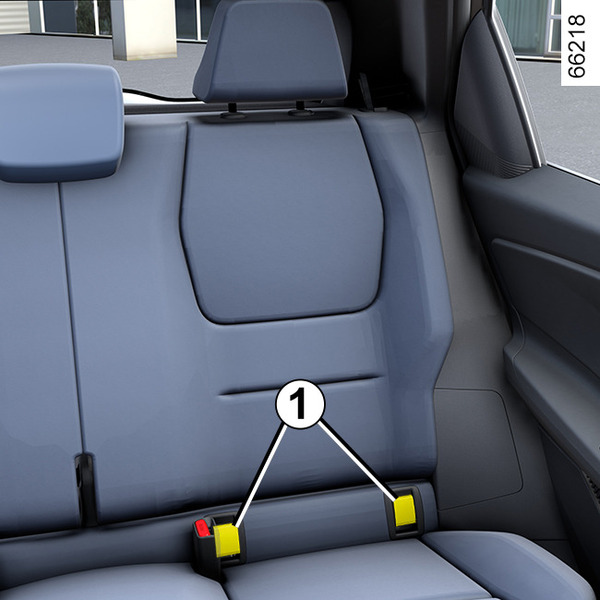
The two rings 1 are located between the seatback and the seat base and are identified by a
 mark.
mark.
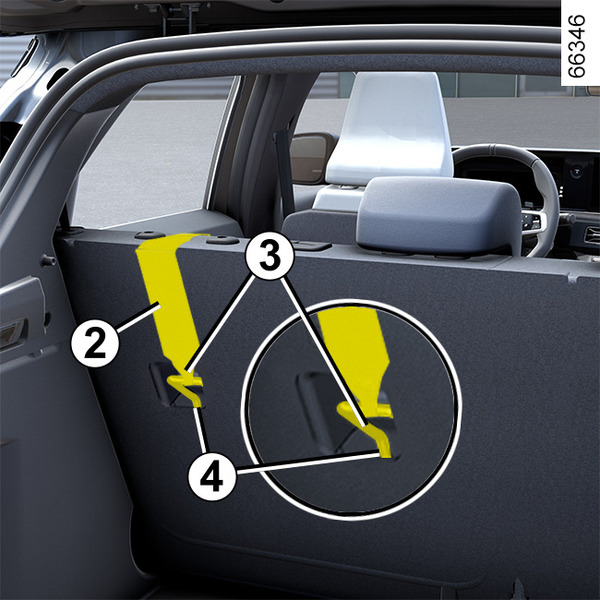
The third ring 4 is used to attach the upper strap 2 on some child seats.
Rear seats
The upper strap 2 should be positioned between the seatback and the rear parcel shelf. To do so, remove the rear parcel shelf Luggage compartment.
Attach the hook 3 to one of the rings 4 marked by the
 symbol.
Front passenger seat
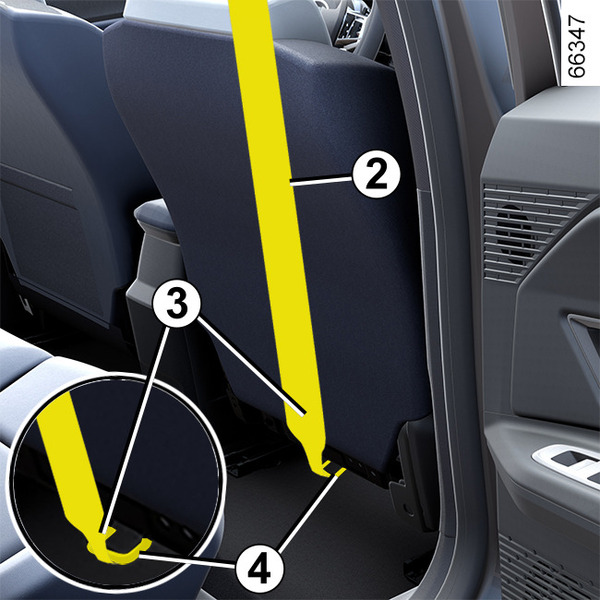
Attach the hook 3 to the upper strap 2 on the ring 4 marked by the
symbol.
All seats
Pull the upper strap 2 so that the back of the child seat comes into contact with the vehicle seatback.
warning
The ISOFIX anchorage points have been exclusively designed for child seats with the ISOFIX system. Never fit a different type of child seat, seat belt or other objects to these fittings.
Check that nothing is obstructing the anchorage points.
If your vehicle has been involved in a road accident, have the ISOFIX anchorage points checked and replace your child seat.
warning
Check that the seatback of the forward-facing child seat is in contact with the seatback of the vehicle seat. In this case, the child seat may not always rest on the seat base of the vehicle seat.
warning
The child seat strap must be attached to the corresponding ring.