A110

Each seat is fitted with a six-point safety harness. It consists of:
- two shoulder straps 1;
- two side straps 2;
- a locking unit 3;
- two crotch straps 4.
The shoulder straps are attached to the side straps at the buckle. The crotch straps are attached to the locking unit.
Always wear your seat belt when travelling in your vehicle. You must also comply with the legislation of the particular country you are in.
Before starting, first adjust your driving position then adjust the safety harnesses for all occupants to ensure optimum protection.
Adjusting your driving position
- Sit well back in your seat (having removed your coat or jacket, etc.). This is essential to ensure that your back is positioned correctly.
- Adjust the distance between the seat and the pedals. Your seat should be as far back as possible while still allowing you to fully depress the pedals.
- Adjust the position of the steering wheel.
Adjusting the safety harness
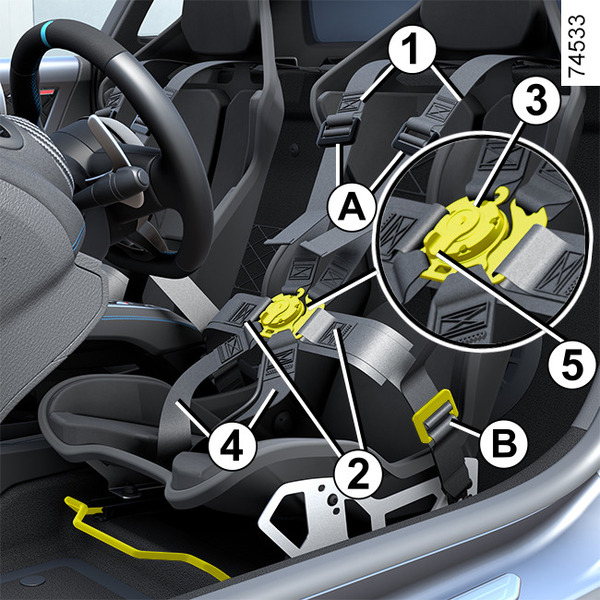
Before starting your journey, you must adjust the safety harness. To do this:
- sit in your seat;
- loosen the shoulder straps 1 by raising the tensioners A while retracting the ends 6 of the straps concerned;
- loosen the side straps 2 by raising the tensioners B while retracting the ends 6 of the straps concerned.
Note: tensioners A and B are repositioned automatically.
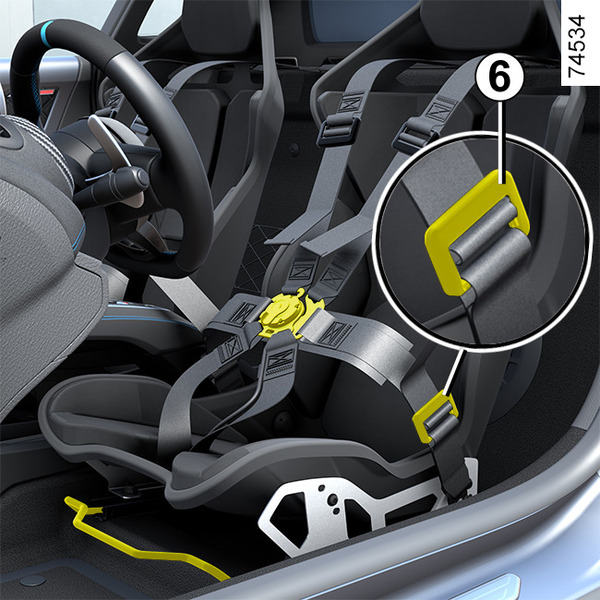
Sit firmly against the seatback, position the locking unit 3 below your navel, then lock each of the two buckles into the corresponding catches on the locking unit 3.
Pull firmly on the ends 6 in order to tighten the straps. The tensioners A must rest on the pectoral muscles. If this is not the case, adjust the length of the shoulder straps then lower the tensioners A.
warning
There is a risk that an incorrectly adjusted safety harness can cause injury during an accident.
The use of the vehicle is not recommended for pregnant women, but even pregnant women must wear their harness.
In this case, ensure that the straps do not exert too much pressure on the navel, but do not allow any slack.
Locking
Ensure that the lever 5 is in the low position. Lock the buckles of the shoulder straps 1 into their corresponding catches on the locking unit 3. Check they are fastened securely by pulling on each of the straps.
warning
No modification may be made to the originally fitted restraint system components: harnesses, seats and their mountings.
- Do not use devices which cause the straps to slacken (e.g. clothes pegs, clips, etc.), as a harness which is worn too loosely risks causing injury in the event of an accident.
- Never pass the shoulder straps under your arms or behind your back.
- Never use the same harness for more than one person and never hold a baby or child on your lap with your harness.
- The harness straps must not be twisted.
- Following an accident, have the harnesses checked and replaced if necessary. Similarly, always replace your harness if it shows any signs of wear.
- Ensure that no objects are placed in the area around the harness locking unit as this could prevent it from working properly.
Unlocking
Tilt the lever 5. The straps are ejected from the locking unit 3. Check that the lever returns to the low position. The crotch straps are inseparable from the locking unit.